cjy
The Home Depot: Redesigning the Item Data Audit Tool
Role: UX Designer
Agency: 3Ci
Timeline: 10 weeks


project overview
The Item Data Audit Tool (IDAT) is a web application used by auditors in distribution centers to enforce item data accuracy for products distributed by The Home Depot. Previously with IDAT 1.0, ‘bad audits' (errors caused by auditors) occurred in roughly 10% of cases, causing inefficiencies, costly rework, and delays across supply chain operations.
Our team was tasked with creating an interface that would reduce these errors and improve overall efficiency across distribution centers.
results at a glance
45%
decrease in bad audits
(10% → 5.5%)
21%
increase in average number of audits performed
process
User Research
-
Remote and in-person interviews with primary users (auditors) and secondary users (supply chain analysts, supply chain managers, distribution center mangers, support specialists)
-
Pain point-, needs-, and opportunity-mapping
-
Persona creation with focus on new, less-experienced auditors as auditors are typically promoted after 2 years.
Prioritization & Alignment
-
Pain point prioritization on Frequency vs. Pain Matrix
-
Alignment with key internal stakeholders: pain points and business goals
Ideation & Design
-
Design Studio
-
Problem statement generation
-
Creative solution generation with internal team and stakeholders (product managers, analysts, developers)
-
Testing & Iteration
-
Usability testing with primary/secondary users
- Validating hierarchy clarity, task efficiency, and error reduction
-
Design Critique
-
Requesting feedback from team members with no prior knowledge of the application to mimic day-one users
-
key business goals
-
Decrease the rate of bad audits to <1%
-
Increase the average number of audits performed
-
Roll out IDAT 2.0 to distribution centers nationwide with minimal training
persona
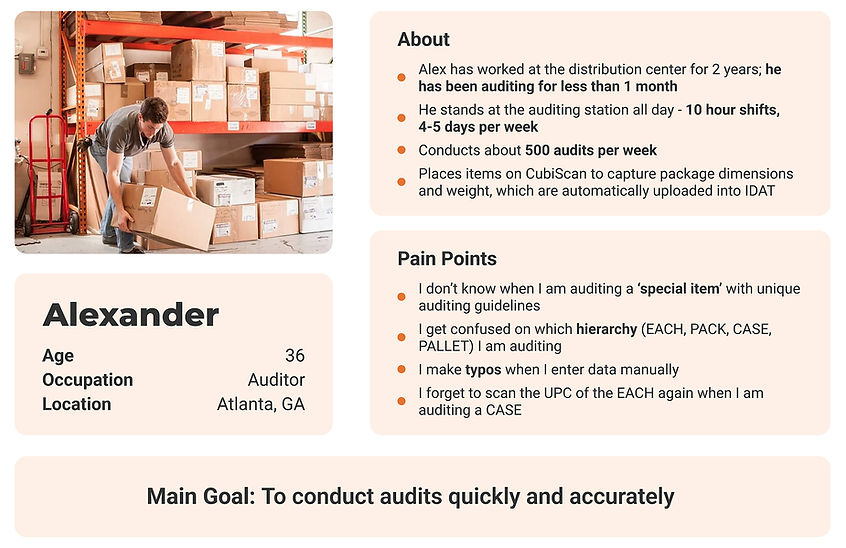
prioritization - frequency/pain matrix

problem statements

top-proposed solutions from design studio

initial designs
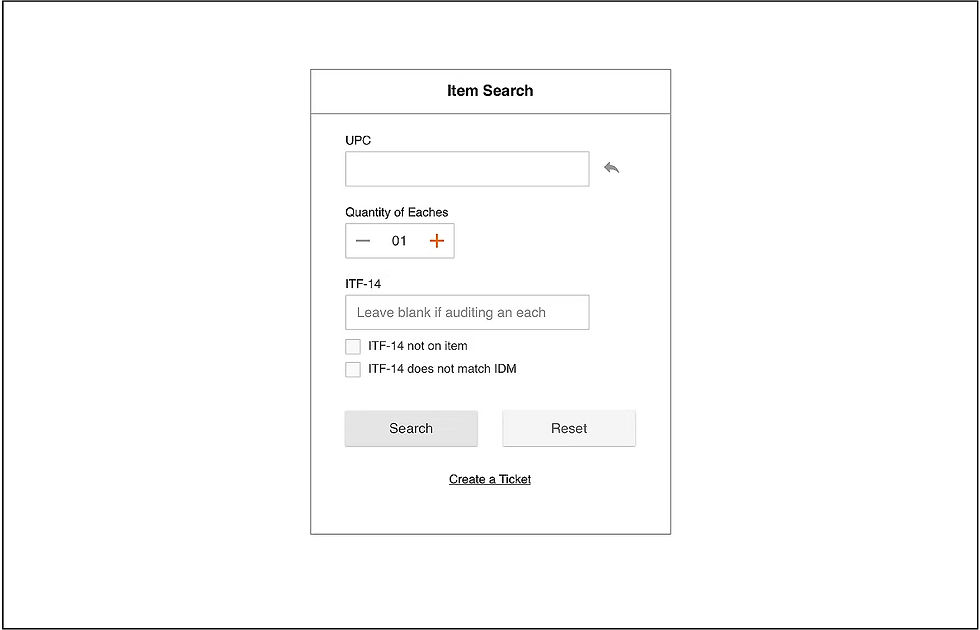


design critique: "day-one user" feedback

prototype video
results and final thoughts
This redesign led to:
📉 45% decrease in bad audits (10% → 5.5%)
📈 21% increase in average number of audits performed
✅ Successful nationwide implementation with minimal training required
While the new bad audit rate did not yet meet the ultimate goal of under 1%, the results clearly showed we were moving in the right direction. The enhancements delivered measurable impact and uncovered additional opportunities for refinement, signaling strong potential for future iterations to continue improving accuracy and efficiency.
Overall, our team collaborated closely to research, design, and implement IDAT 2.0. This was our first project together, and it was rewarding to introduce the team to user-centered design principles and see how empathy for the end user transformed the way we approached problem-solving.


